
A Masterball market price is built from what cards actually sold for, not what people are asking. Raw cards and every grade are priced separately, and every price in the app shows the sales behind it so you can check it yourself.
Sales first, guides second
Asking prices tell you what a seller hopes to get. Completed sales tell you what a buyer paid. Masterball reads completed sales from eBay and the major auction houses first, then fills the gaps with the largest price guides when a card has not sold recently.
Raw and graded are different markets
A raw Near Mint card and the same card in a PSA 10 slab can be worth wildly different amounts, so Masterball treats them as separate prices. Graded prices are kept apart by company and by grade, and special labels such as a BGS Black Label or a CGC Pristine 10 get their own price instead of being averaged into a plain 10.
Recent sales, not one lucky sale
One sale can be an outlier. For graded vintage cards, the market price follows the most recent handful of sales at that exact grade. For raw cards, it follows the middle of the recent sales, so a single high or low sale does not move the price on its own. When live listings are clearly below the market, the price is held to what the market is really offering.
Check the receipts
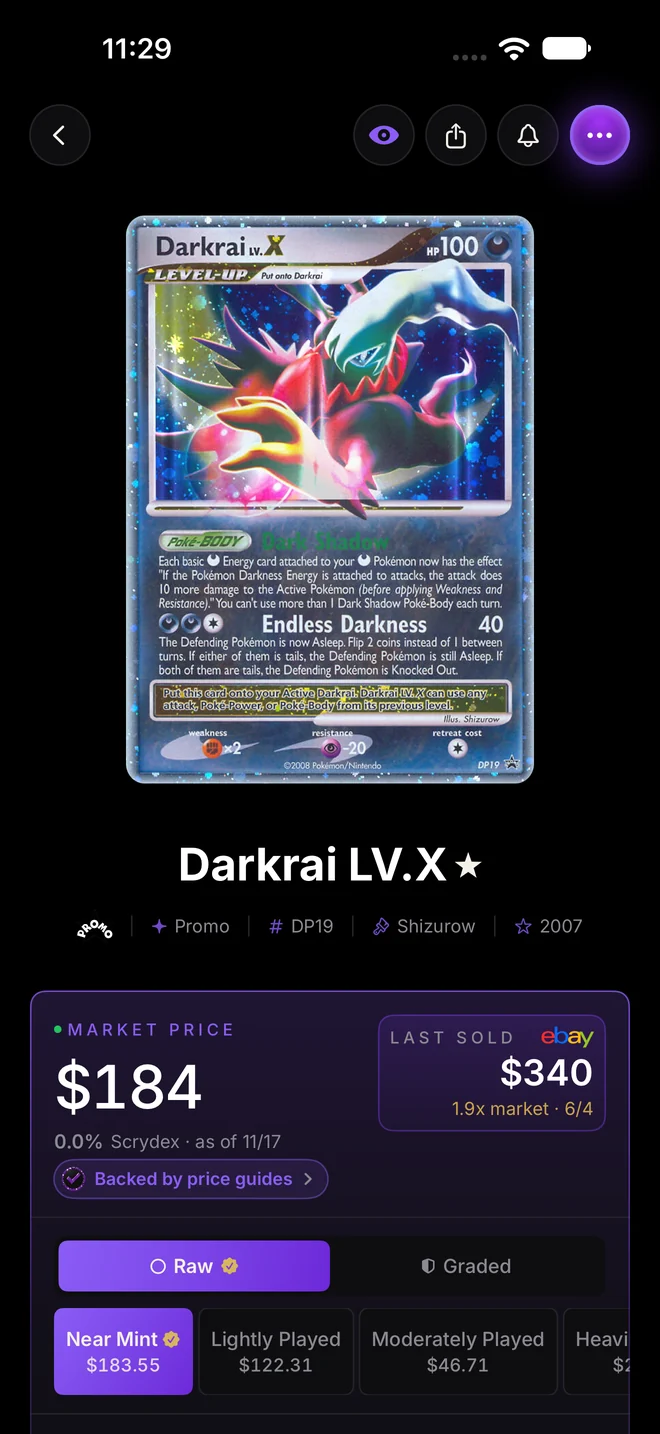
Tap any market price in Masterball and you get its proof:
- Every sale it is built from, with the date, the price and where it sold
- Whether the price is Proven by sales, Backed by guides, or an Estimate
- What live listings say right now
If a number cannot show where it came from, it should not be on your collection.